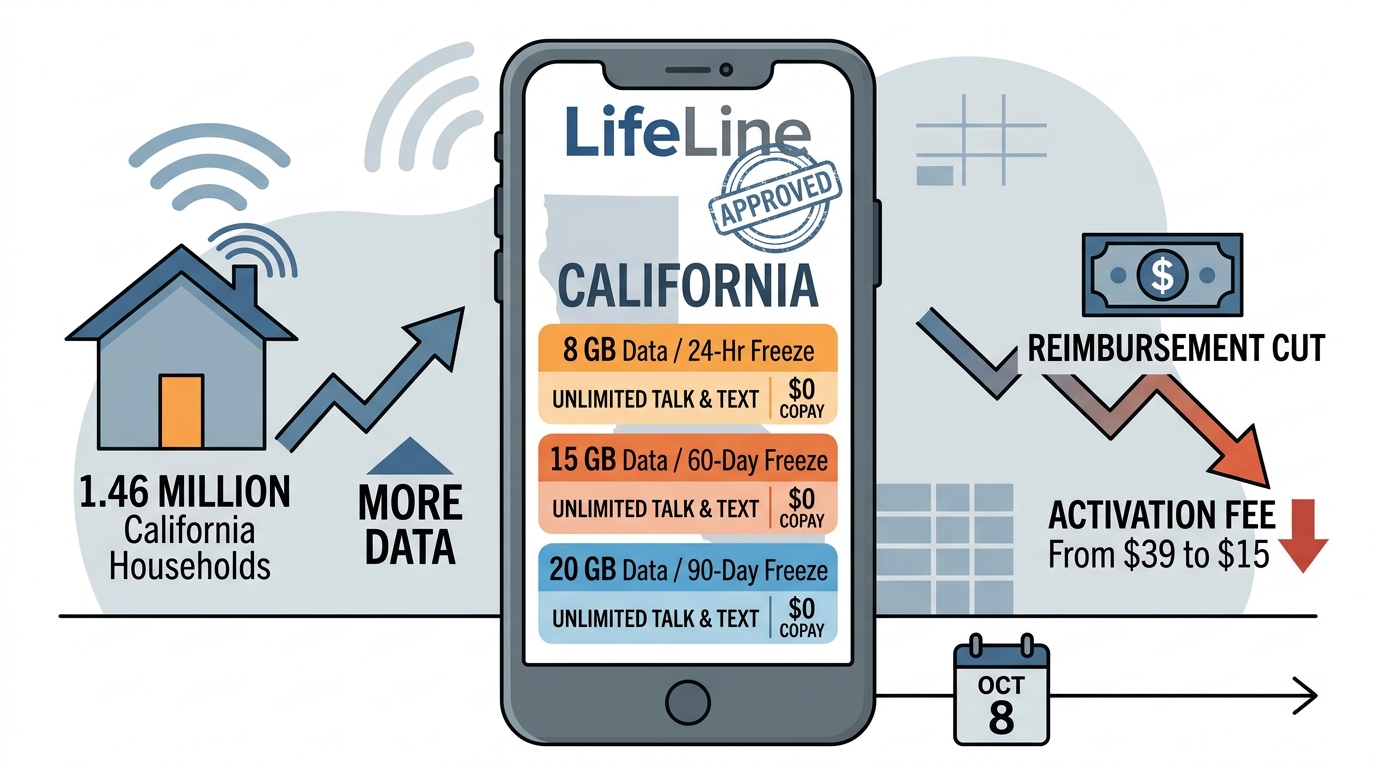
The California Public Utilities Commission approved a new set of wireless California LifeLine benefits Oct. 8, giving eligible customers more data at the same $20 monthly state subsidy while reducing the reimbursement providers receive for activating service.
The commission signed Decision D.26-10-034 in item 49 of its telecommunications agenda. The official meeting results show all five commissioners voting yes.
The adopted framework creates three zero-copay wireless tiers, each with unlimited talk and text: 8 gigabytes of data with a 24-hour portability freeze, 15 gigabytes with a 60-day freeze, or 20 gigabytes with a 90-day freeze. The tiers must provide standard 4G or 5G speeds and tethering, according to the CPUC decision materials. Customers who receive the federal $9.25 mobile Lifeline benefit can receive an additional 4.5 GB under the adopted rules.
The commission also reduced wireless activation or connection reimbursement from as many as two $39 payments per service year to one $15 reimbursement per participant per year. CPUC materials say the change is intended to track lower prepaid-market activation fees. Residents and representatives of St. Francis Manor were among public commenters who opposed the reduction, warning it could affect the availability of free phones and tablets.
The rules add new requirements for customers who stop using wireless service. A subscriber who has not used the service for 30 days must receive clear notice and then has 15 more days to use the service before possible de-enrollment. Qualifying use includes an outbound call or data use, buying data, answering an incoming call from someone other than the provider or its agent, confirming directly with the provider that service should continue, or sending a text. Providers must report extended nonuse and monthly removals with reimbursement claims, and must notify customers of the rule change within 45 days of the decision’s issuance.
The CPUC said in its Oct. 8 release that about 1.46 million California households participating in both the state and federal programs would receive more than twice the prior data allowance. That figure should not be confused with a separate CPUC annual-report figure for approximately 1.46 million California LifeLine subscribers as of June 30, 2024.
The decision took effect when it was issued Oct. 8, though the CPUC’s final signed decision and General Order 153-A attachment should be consulted for any later deadlines governing tier availability, reimbursement claims or provider filings. The Oct. 8 CPUC voting meeting included discussion of the proposal and concerns from low-income-service advocates about the reimbursement change.