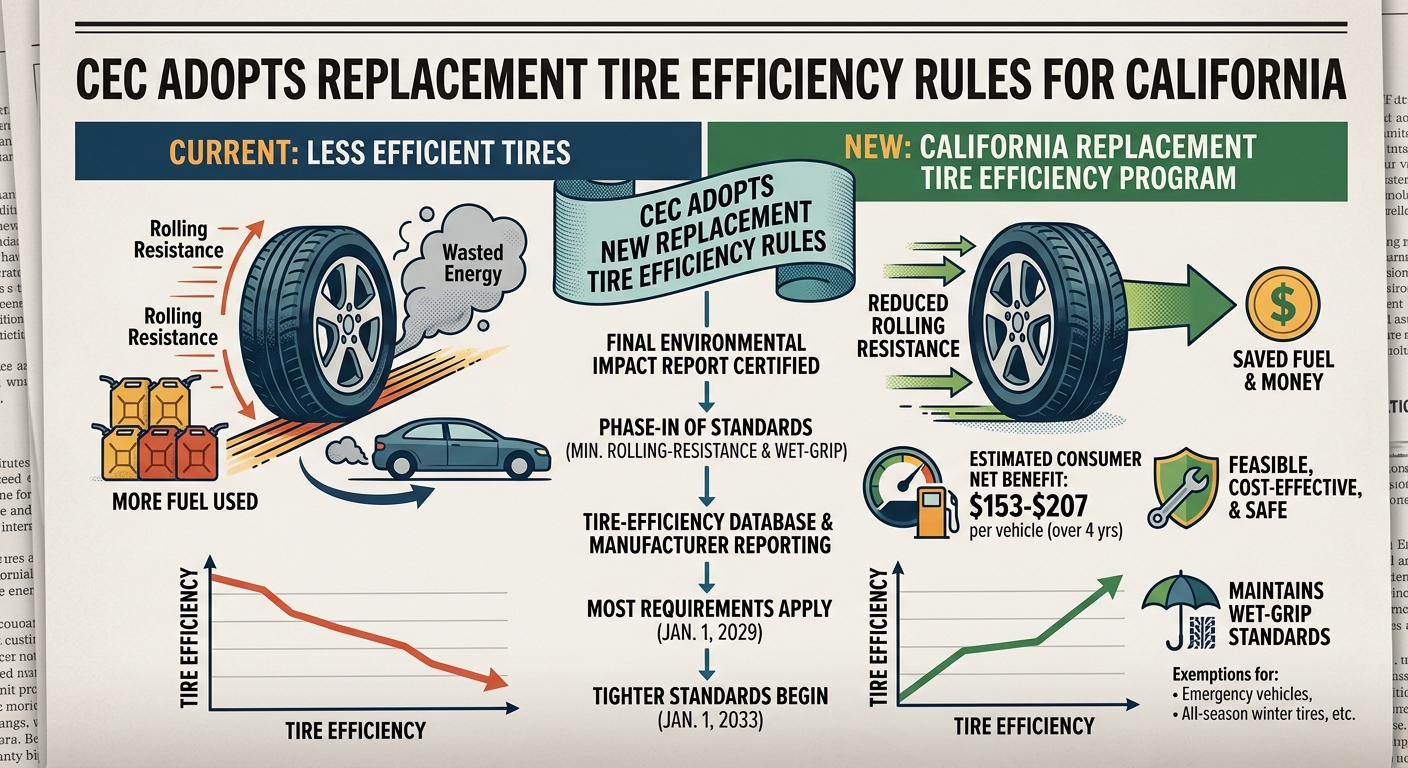
The California Energy Commission on Aug. 17 certified the final environmental impact report and adopted regulations for the statewide Replacement Tire Efficiency Program, advancing a rulemaking that is intended to make replacement tires sold in California, on average, at least as energy efficient as original equipment tires for passenger cars and light-duty trucks.
In the resolution and staff materials for Item 9 at the commission’s business meeting, staff said the program will phase in minimum rolling-resistance and wet-grip standards, create a tire-efficiency database, and require reporting from manufacturers and brand-name owners. The package also includes exemptions for authorized emergency vehicles, all-season winter performance tires and some last-resort tires when compliant replacements are not available in sufficient quantities.
The staff report says the commission found the rule package technically feasible and cost-effective and concluded it would not significantly harm tire safety, tire life or the scrap-tire system. It also cites third-party testing of 179 tire models and estimates consumer fuel savings, with a net benefit of $153 to $207 per vehicle over a typical four-year tire lifespan.
The adopted rules take effect in phases, with most requirements applying to tires manufactured on or after Jan. 1, 2029, and tighter standards beginning Jan. 1, 2033, according to the express terms in the rule package. The resolution also directs staff to prepare the final statement of reasons, file the rulemaking with the Office of Administrative Law and complete CEQA filing steps.
The commission’s adoption follows a public process that included a 2024 notice of preparation, a spring 2026 notice of proposed action, a June 10 public hearing, an additional comment period in July and August, and publication of the final EIR on Aug. 7.